High-performance sewing applications often require a thread that can remain stable when exposed to heat, aggressive chemicals, moisture, abrasion, and demanding outdoor conditions. PTFE Sewing Thread is engineered around the distinctive properties of polytetrafluoroethylene, making it suitable for technical textiles and industrial assemblies where conventional sewing materials may struggle. Its combination of thermal stability, chemical resistance, low friction, weather resistance, and durability makes it relevant to filtration systems, protective covers, industrial fabrics, marine products, technical textiles, and other specialized applications. Selecting the correct thread requires more than looking at material composition alone. Thread construction, sewing conditions, needle selection, tension, fabric structure, environmental exposure, and finished-product requirements all influence performance. This guide explains the major characteristics, application considerations, manufacturing factors, sewing practices, maintenance requirements, and selection criteria that help technical teams make better decisions.
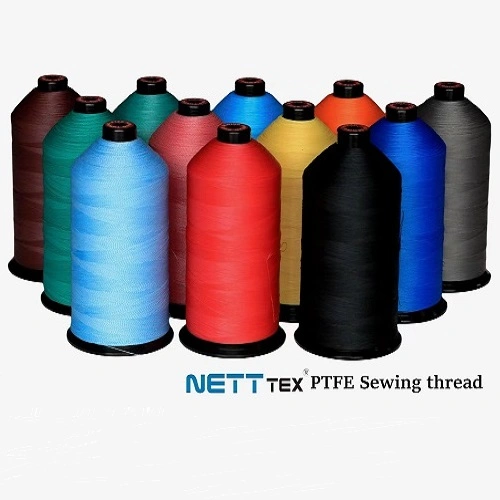
1. What Makes PTFE Thread Different From Conventional Sewing Thread?
Sewing thread may appear simple, but its technical role is critical when multiple layers of specialized fabric must remain securely joined under harsh operating conditions. Ordinary textile threads are often designed around general apparel or conventional fabric applications, whereas industrial sewing can expose the seam to elevated temperatures, corrosive substances, ultraviolet radiation, continuous moisture, mechanical friction, and repeated movement.
PTFE Sewing Thread is based on polytetrafluoroethylene, a fluoropolymer recognized for a distinctive combination of thermal stability, chemical inertness, low surface friction, and resistance to environmental degradation. These characteristics make it particularly relevant when the thread itself must remain functional even though the surrounding fabric is exposed to demanding conditions.
Another important characteristic is dimensional and chemical stability. The thread should not be treated simply as a fastening accessory. In technical products, the seam is part of the overall structure, and its performance can influence filtration efficiency, cover integrity, containment, weather protection, and the service condition of the finished assembly.
Material properties should match the operating environment
The best thread is not necessarily the strongest material in isolation. Instead, the material should match the complete operating environment. A textile used near high temperatures may prioritize thermal stability, while a chemical-processing application may place greater emphasis on resistance to corrosive exposure. Outdoor products may require strong resistance to ultraviolet radiation and weathering.
- Evaluate temperature exposure before choosing the thread material.
- Consider direct and indirect chemical contact during service.
- Assess moisture, humidity, ultraviolet radiation, and outdoor exposure.
- Match thread construction with the fabric structure and seam design.
- Review sewing-machine compatibility before production begins.
2. Why Is Thermal Stability Important in Industrial Sewing?
Temperature can influence both textile materials and the sewing thread that holds them together. In ordinary applications, the operating temperature may remain within a relatively comfortable range. Industrial environments can be very different. Equipment may generate heat, products may pass through elevated-temperature processes, or the finished textile may operate close to a hot surface.
A thread that loses its functional characteristics under thermal stress can weaken the seam even when the base fabric remains intact. This is particularly important in industrial filter bags, thermal covers, protective fabrics, oven-related equipment, and other products exposed to elevated temperatures.
PTFE's thermal characteristics make it useful in situations where conventional sewing materials may experience limitations. The actual operating temperature, exposure duration, pressure, movement, and surrounding materials should still be evaluated individually because the performance of a finished seam depends on the entire assembly rather than the thread alone.
Heat exposure is not always constant
Engineers should consider both continuous and intermittent heat. A material that performs adequately during a short exposure may behave differently when exposed repeatedly over a long service period. Temperature cycling can also create expansion and contraction in the surrounding materials, which places additional mechanical demands on the seam.
For this reason, the sewing construction should be considered together with the thread material. Stitch density, seam geometry, fabric thickness, and thread tension can all affect how thermal stress is transferred through the finished product.
3. How Does Chemical Resistance Affect Thread Selection?
Chemical exposure is one of the clearest reasons to move beyond conventional textile threads. Industrial fabrics can encounter acids, alkalis, solvents, process gases, cleaning chemicals, and other aggressive substances. When the seam is exposed to the same environment as the fabric, thread selection becomes an important part of the product design.
PTFE is known for high chemical resistance and low reactivity across a broad range of chemical environments. This characteristic can help maintain seam integrity where a less resistant material might deteriorate or lose useful performance.
Chemical compatibility should always be evaluated against the actual substances involved. Concentration, temperature, contact duration, pressure, and exposure frequency can all influence material behavior. A general statement about chemical resistance should therefore be used as a starting point for engineering evaluation rather than as a substitute for application-specific testing.
| Environmental Factor | Key Question | Design Consideration |
|---|---|---|
| Heat | What temperature will the seam experience? | Evaluate continuous and intermittent exposure. |
| Chemicals | Which substances can contact the seam? | Check material compatibility under actual conditions. |
| Moisture | Will water remain around the seam? | Consider drainage, drying, and environmental exposure. |
| Abrasion | Will the seam rub against equipment or fabric? | Select a construction that tolerates repeated friction. |
| Ultraviolet Radiation | Will the finished product remain outdoors? | Evaluate long-term weathering resistance. |
4. Which Industrial Materials Can Be Sewn With PTFE Thread?
Technical textiles frequently differ from ordinary fabrics in thickness, stiffness, coating, surface texture, and reinforcement. Materials such as fiberglass fabrics, coated textiles, heavy-duty industrial cloth, protective fabrics, and filtration materials may require a sewing thread with specialized characteristics.
The compatibility between thread and fabric should be evaluated at the seam level. A technically advanced thread cannot compensate for an unsuitable needle, excessive machine tension, incorrect stitch density, or a fabric that has been damaged during sewing.
Fiberglass and reinforced technical fabrics
Fiberglass fabrics can be abrasive to sewing equipment and may place unusual demands on the thread. The seam must remain stable while the fabric retains its structural properties. Proper needle selection and controlled machine settings are especially important when working with stiff or reinforced materials.
Filter materials
Filtration fabrics require reliable seams because the finished product may be exposed to dust, heat, chemical gases, moisture, and repeated cleaning cycles. The thread should complement the filtration medium rather than creating an avoidable weak point in the construction.
Outdoor and protective fabrics
Heavy-duty covers, architectural fabrics, protective curtains, industrial tarpaulins, and specialized outdoor textiles may remain exposed to sunlight, rain, wind, and temperature changes for extended periods. The thread must therefore contribute to the durability of the finished seam rather than merely hold the layers together during initial assembly.
5. How Does Thread Construction Influence Sewing Performance?
Material chemistry is only one part of thread performance. Construction determines how the thread behaves while passing through the machine, forming stitches, and interacting with the fabric. Filament arrangement, diameter, twist, surface characteristics, and consistency can influence sewing stability.
A uniform thread helps maintain consistent stitch formation. Variations in diameter or construction can influence tension and may produce irregular stitches, especially when machines operate at higher speeds. For technical applications, consistency is therefore an important manufacturing consideration.
- Select a thread construction appropriate for the fabric thickness and seam requirements.
- Check that the thread passes smoothly through the selected needle and machine path.
- Establish suitable upper and lower thread tension.
- Verify stitch formation at the intended machine speed.
- Inspect finished seams for skipped stitches, looping, fraying, or excessive distortion.
The relationship between thread and machine should be treated as a system. Even a high-performance material can produce poor results if the machine configuration does not match its characteristics.
6. What Sewing Conditions Should Be Optimized?
Industrial sewing requires repeatability. A seam that looks acceptable during one manual adjustment should also remain stable when the same operation is repeated across hundreds or thousands of components. Process control is therefore central to reliable technical sewing.
Needle size is one of the first variables to consider. A needle that is too small may create excessive resistance, while an unsuitable needle can damage delicate or coated materials. Machine speed also affects heat generation, thread movement, and stitch formation.
Thread tension deserves careful attention. Excessive tension can distort the fabric or place unnecessary stress on the thread. Insufficient tension can produce loose or irregular stitches. The correct setting depends on the machine, thread construction, fabric, stitch type, and seam design.
- Use a needle appropriate for the material being sewn.
- Adjust thread tension gradually rather than making large changes.
- Check stitch quality at the actual production speed.
- Inspect both sides of the seam for balanced stitch formation.
- Monitor thread path friction and machine contact points.
7. How Does Abrasion Resistance Support Long-Term Performance?
Abrasion is a common source of seam degradation. A finished product may experience repeated folding, vibration, rubbing, handling, movement against equipment, or contact with adjacent textile layers. If the thread surface deteriorates quickly, the seam can gradually lose structural reliability.
PTFE's low-friction characteristics can be useful in applications where the thread repeatedly passes through fabric or experiences mechanical interaction. Its durability and resistance to environmental stress can also support demanding industrial constructions.
However, abrasion resistance is influenced by the whole seam. Stitch geometry, thread diameter, fabric edges, seam allowance, and mechanical loading all contribute to how stress is distributed. A strong thread should therefore be paired with a seam design that avoids unnecessary concentrated loads.
Look beyond thread strength alone
A reliable seam distributes load across multiple stitches rather than placing all stress on a single point. The number of stitches per unit length, seam width, thread path, and fabric condition should be selected according to the application.
This approach is particularly important for products that are frequently folded or flexed. Repeated movement can create different stress patterns from a static load, making seam construction a key part of long-term performance.
8. Why Is Weather Resistance Valuable for Outdoor Products?
Outdoor textile products encounter a combination of environmental stresses rather than a single exposure. Sunlight, rain, humidity, temperature changes, wind, airborne contaminants, and repeated cleaning can all influence the finished seam.
PTFE Sewing Thread can be valuable in outdoor applications because PTFE is recognized for strong resistance to weathering and environmental degradation. This makes it relevant to heavy-duty covers, tents, protective fabrics, outdoor equipment covers, and other technical textile constructions.
Weather-resistant thread should still be integrated with suitable fabric and hardware. If the thread remains stable while the surrounding fabric or fasteners degrade, the finished product may still fail. A durable design therefore evaluates all exposed components together.
9. What Applications Benefit From PTFE Thread?
The range of possible applications is broad because the material's properties address several common industrial challenges at once. Its thermal and chemical characteristics make it suitable for specialized environments, while its durability and environmental resistance support outdoor and heavy-duty products.
| Application Area | Primary Requirement | Important Thread Characteristic |
|---|---|---|
| Industrial Filtration | Stable seams under demanding process conditions | Thermal and chemical resistance |
| Outdoor Covers | Resistance to weather and repeated handling | Weathering and abrasion resistance |
| Technical Textiles | Reliable joining of specialized fabrics | Durability and process consistency |
| Chemical Equipment | Resistance to aggressive environments | Chemical stability |
| Marine Fabrics | Resistance to moisture and outdoor exposure | Environmental durability |
| Protective Covers | Repeated movement and environmental stress | Abrasion and weather resistance |
Application requirements should always be translated into measurable operating conditions. Instead of simply asking whether a thread is suitable for an industry, evaluate the temperature range, chemical exposure, mechanical load, moisture level, expected service duration, cleaning process, and sewing configuration.
10. How Can Filter Bag Construction Benefit From Specialized Thread?
Filter bags are a particularly important technical textile application because their seams may operate in environments containing dust, heat, moisture, chemicals, and continuous airflow. The filter medium must retain its intended structure while the sewing thread maintains seam integrity.
Seam quality is essential because an imperfect seam can become a weak point even when the filter fabric itself has excellent filtration characteristics. The thread therefore needs to complement the material rather than introducing a vulnerability.
Sewing parameters should be adapted to the filter material. Excessive needle penetration can damage fibers, while poor tension can create loose seams. The correct construction should provide secure joining while minimizing unnecessary disturbance to the filtration medium.
Cleaning cycles should also be considered
Some filtration systems use repeated cleaning processes to remove accumulated particles. Mechanical movement, pressure changes, and environmental exposure can place additional stress on seams. When selecting thread, the entire maintenance cycle should therefore be included in the evaluation rather than considering only the initial operating condition.
11. How Should Thread Size and Sewing Equipment Be Matched?
Thread diameter and machine configuration should be compatible with the fabric and required seam strength. A heavier thread may provide a robust construction, but it also requires appropriate needle dimensions, machine capability, and tension control.
Thread that is too large for the needle can create excessive friction and inconsistent stitch formation. Thread that is too small for the application may not provide the desired mechanical performance. The goal is a balanced combination of thread size, stitch structure, fabric thickness, and machine settings.
- Identify the thickness and structure of the fabric assembly.
- Determine the required seam configuration and expected mechanical loading.
- Select a compatible needle and thread size.
- Set machine tension and speed according to the material combination.
- Inspect sample production runs for stitch consistency and fabric damage before continuous production.
Production teams should also monitor machine wear. Guides, tension components, needle systems, and thread paths can affect the consistency of sewing. Routine inspection helps prevent equipment-related variation from being mistaken for a thread-quality problem.
12. What Quality Factors Should Manufacturers Evaluate?
Quality control should cover both incoming thread and finished seams. A technically suitable material still needs consistent production quality so that every spool behaves predictably during sewing.
- Check thread diameter and construction consistency.
- Inspect winding quality and spool presentation.
- Evaluate surface uniformity and visible defects.
- Monitor tensile and elongation characteristics according to the intended application.
- Verify sewing behavior under actual machine conditions.
- Inspect finished seams for skipped stitches, broken thread, puckering, and irregular tension.
Manufacturing consistency is especially important when technical textiles are produced in repeated batches. A stable thread specification can help reduce process variation and make machine settings easier to standardize across production runs.
Packaging and storage also matter
Even a durable fluoropolymer thread should be stored appropriately. Spools should be protected from contamination, physical damage, and unnecessary exposure to conditions that could interfere with handling. Clean packaging helps prevent foreign particles from entering the sewing process.
13. How Can Finished Seams Be Protected During Service?
The finished seam is exposed to the same environment as the rest of the product, but its geometry can make it particularly sensitive to mechanical stress. Sharp folds, concentrated loads, repeated bending, and contact with rigid components can all influence seam behavior.
Proper seam allowance helps distribute mechanical loading. Where appropriate, reinforcement can be added to high-stress locations. The finished product should also avoid unnecessary sharp bending at the seam because repeated folding can concentrate stress in a small area.
Cleaning procedures should be compatible with the entire assembly. Strong mechanical cleaning or inappropriate chemicals can damage the fabric even when the thread itself is resistant. Maintenance teams should therefore consider the fabric, coating, thread, hardware, and any protective finish as a combined system.
14. What Should Buyers Consider Before Choosing a Supplier?
Supplier evaluation should begin with technical capability rather than product naming alone. A suitable supplier should be able to explain material characteristics, thread construction, available specifications, production consistency, application compatibility, and quality-control practices.
Clear technical communication is particularly important for specialized sewing materials. Different applications may require different thread sizes, constructions, colors, winding formats, or performance characteristics. A supplier that understands the end application can help the production team define a more suitable specification.
Documentation and traceability are also useful for industrial production. Consistent product identification helps manufacturers maintain repeatable purchasing and production records. When a sewing process has been optimized, maintaining a stable thread specification can help preserve the same machine settings and seam behavior.
- Confirm the material type and intended technical specification.
- Review available thread sizes and construction options.
- Ask how dimensional and production consistency are controlled.
- Discuss the intended operating environment and sewing conditions.
- Confirm packaging, identification, and production traceability requirements.
- Evaluate technical communication and after-sales support capabilities.
PTFE Sewing Thread should ultimately be selected according to the finished product's operating environment rather than by material name alone. Temperature, chemicals, mechanical stress, weather exposure, fabric type, machine configuration, and seam geometry all need to be considered together.
15. Frequently Asked Questions
What is PTFE thread made from?
It is produced from polytetrafluoroethylene, a synthetic fluoropolymer known for high chemical resistance, thermal stability, low friction, and strong resistance to environmental exposure.
Why is PTFE thread used for industrial sewing?
It can provide useful performance in applications where the seam may encounter elevated temperatures, aggressive chemicals, moisture, abrasion, ultraviolet exposure, or other demanding conditions.
Can PTFE thread be used with fiberglass fabrics?
It can be suitable for fiberglass and other technical fabrics, particularly when the application requires resistance to demanding environmental conditions. Needle selection, machine tension, fabric construction, and stitch design still need to be optimized.
Is PTFE thread suitable for outdoor products?
Its resistance to weathering and environmental degradation makes it relevant to many outdoor technical textile applications, including protective covers and specialized fabrics.
How should the correct thread size be selected?
Thread size should be matched with fabric thickness, seam design, required mechanical performance, needle dimensions, machine capability, and the intended sewing speed.
Does PTFE thread require special sewing settings?
Sewing settings should be optimized for the specific thread construction and fabric combination. Needle selection, tension, machine speed, thread path, and stitch density can all affect finished seam quality.
Can PTFE thread resist chemical exposure?
PTFE is recognized for broad chemical resistance, but actual suitability depends on the chemical, concentration, temperature, exposure duration, and complete operating environment.
What industries can use PTFE-based sewing materials?
Potential applications include industrial filtration, chemical processing equipment, technical textiles, outdoor protective products, marine fabrics, specialized covers, and other demanding industrial constructions.
16. Final Selection Perspective
Choosing a sewing thread for a demanding technical application requires a systems-based approach. The thread is only one component of the finished construction, but it can become a critical performance point when the seam is exposed to heat, chemicals, abrasion, moisture, ultraviolet radiation, or repeated mechanical movement.
The most effective selection process begins with the operating environment. Define the temperature range, chemical exposure, mechanical loads, weather conditions, fabric structure, cleaning process, and expected service requirements. Then match the thread material and construction with the needle, machine, stitch design, and fabric.
Consistency is equally important. A reliable industrial sewing process depends on predictable thread behavior from spool to spool. Stable winding, uniform construction, suitable packaging, controlled machine settings, and systematic seam inspection can all contribute to repeatable production quality.
For specialized fluoropolymer sewing requirements, Suzhou NETT new material technology Co., LTD. provides technical textile material solutions with a focus on PTFE-related products and industrial applications.
The right material selection can help manufacturers build seams that remain dependable under demanding conditions while supporting the durability and functionality of the finished textile product. Careful engineering at the sewing stage can therefore make a meaningful difference to the performance of the complete assembly.
Need to discuss a PTFE-based sewing application, technical textile requirement, or suitable thread specification?
contact us to discuss your requirements